Showing posts with label queen victoria. Show all posts

Thursday, April 28, 2011

Countdown to the Royal Wedding - Royal Wedding Gowns

Welcome to the Gracie Jewellery countdown to the Royal Wedding- Part 14
1 Day to go

Queen Victoria 1840

Princess Alexandra - the future Queen Alexandra - 1863

Princess May of Teck - the future Queen Mary - 1893


Lady Elizabeth Bowes Lyons - the future Queen Elizabeth the Queen Mother -1923


Princess Elizabeth - now Her Majesty The Queen - 1947

Princess Margaret Rose - Countess of Snowdon - 1960

Princess Anne - The Princess Royal - 1973

Diana - Princess of Wales - 1980

Sarah Ferguson - The Duchess of York - 1986

The Hon. Serena Stanhope - Viscountess Linley - 1993

Lady Sarah Armstrong-Jones - Lady Sarah Chatto - 1994

Sophie Rys-Jones - Countess of Wessex - 1999

Camilla Parker-Bowles - The Duchess of Cornwall - 2005

Autumn Kelly - 2008

Next time - The Royal Invitation


Monday, April 25, 2011

Countdown to the Royal Wedding - The Royal Regalia

Welcome to the Gracie Jewellery countdown to the Royal Wedding- Part 11
4 Days to go


The items that comprise the Crown Regalia are not just decorative objects but the visible proof of royalty; they are symbols of the power and authority handed down from generation to generation. The Crown Regalia belongs to the State and is displayed to the public in the Jewel House of the Tower of London-attracting nearly two million visitors a year.


The King George IV State Diadem
In 1821 King George IV was busy acting as stage manager for his won Coronation and designed a completely new crown for the ceremony. He wanted his crown to have a floral design, but the Privy Council ruled that this would be improper, at the Coronation crown had always had fleur-de-lys motifs, even prior to Edward the Confessor. Instead he used the floral emblems for his diadem and but a last minute change of mind he never wore it. In 1838 the diadem was reset with pearls and diamonds from the royal collection and worn for the first time by Queen Victoria at her Cornonation. For the next thirty years she wore it constantly: at her children's christenings and weddings; at State banquets; even at a dinner at Cambridge University. She is pictured wearing it on the world's first postage stamp issued in 1840.

The completely circular diadem has four crosses pattee set with diamonds, repesenting St. George, the front one with a rare honey-coloured diamond in the centre; and four diamond bouquets incorporating roses, thistles and shamrocks, the emblems of the United Kingdom. The diamond scrollwork band, remounted for Queen Alexandra in 1902, is framed between two rows of pearls-eighty one in the upper row and eighty eight in the lower row.


The Queen inherited the diadem in 1952 on the death of her father. Because the Queen wears the diadem to and from the State Opening of Parliament each year, and is pictured with it on all United Kingdom postage stamps, the diadem is seen by more millions of people than any other item of royal jewellery.


The Imperial State Crown is a copy of the one made for King George IV's Coronation in 1821 and has an open work frame thickly encrusted with diamonds. The frame is gold, the settings of the stones are silver. The circumference is 23¼", the height 12 3/8" and it weighs 2 lbs 13 oz. It is set with 2,873 diamonds, 273 pearls, 17 sapphires, 11 emeralds and 5 rubies. The circlet base has alternate emeralds and sapphires surrounded by diamonds. In the centre front is the 317.4 carat Cullinan II, the Second Star of Africa set in the crown by King George V in 1911. Above is a band of 109 pearls invisibly strung as a necklace, and below is another string of 128 pearls. Mounted on the circlet are upright fleurs-de-lys and crosses pattee covered in diamonds with emeralds and rubies set alternately as the centre stones of each motif. Just above the Cullinan II in a jewelled Maltese cross, is a giant irregularly shaped ruby spinel known as the "Black Prince's ruby". The crown's four oak leaf covered arches are set with rose-cut diamonds and oriental pearl acorns. At the apex, below the diamond set globe, hang four large pear shaped pearl drops. Atop all is the diamond cross pattee with the most ancient gem in all the Regalia. This is a square sapphire, ½" across, that was said to have been set in the 1043 Coronation Ring of King Edward the Confessor, the last of the Saxon line. When the Cullinan diamond was set in the crown for the 1911 Coronation for King George V, it replaced a very large oblong partly pierced sapphire, 1 3/4 by 1 1/16 inches and one inch thick, which was then moved to a similar position at the back of the browband.

Queen Victoria wore this crown for her Coronation. At the State banquet that night, Lord Melbourne complained that he had found the Sword of State very heavy to carry, the Queen told him: "So was the Crown. It hurt me a good deal."

When King George V wore the crown for the 1924 State Opening he wrote: My speech was, I think, the longest on record and took 20 minutes to read. The crown gave me an awful headache. I could not have borne it much longer."


Queen Elizabeth on her Coronation Day june 2, 1953. Her Majesty is wearing the purple Cornonation Robe trimmed with ermine, gold Garter Collar and dress of white satin with coloured beaded embroidery of the flower emblems of Great Britain and the Dominions, among them the English Tudor rose, Scottish thistle, Irish shamrock, Welsh leek, Canadian maple leaf, Australian wattle and Indian lotus flower. Photographer Cecil Beaton was waiting to take the official photographs and later wrote in his diary: 'The Queen looked extremely minute under her robes and Crown, her nose and hands chilled and her eyes tired. "Yes", in reply to my question, "the Crown does get rather heavy." She had been wearing it for nearly three hours.'

Next time - The Royal Family Orders

from the book - The Queen's Jewels by Leslie Fielding

Friday, April 22, 2011

Countdown to the Royal Wedding - Coloured Stones

Welcome to the Gracie Jewellery countdown to the Royal Wedding- Part 8
7 Days to go.


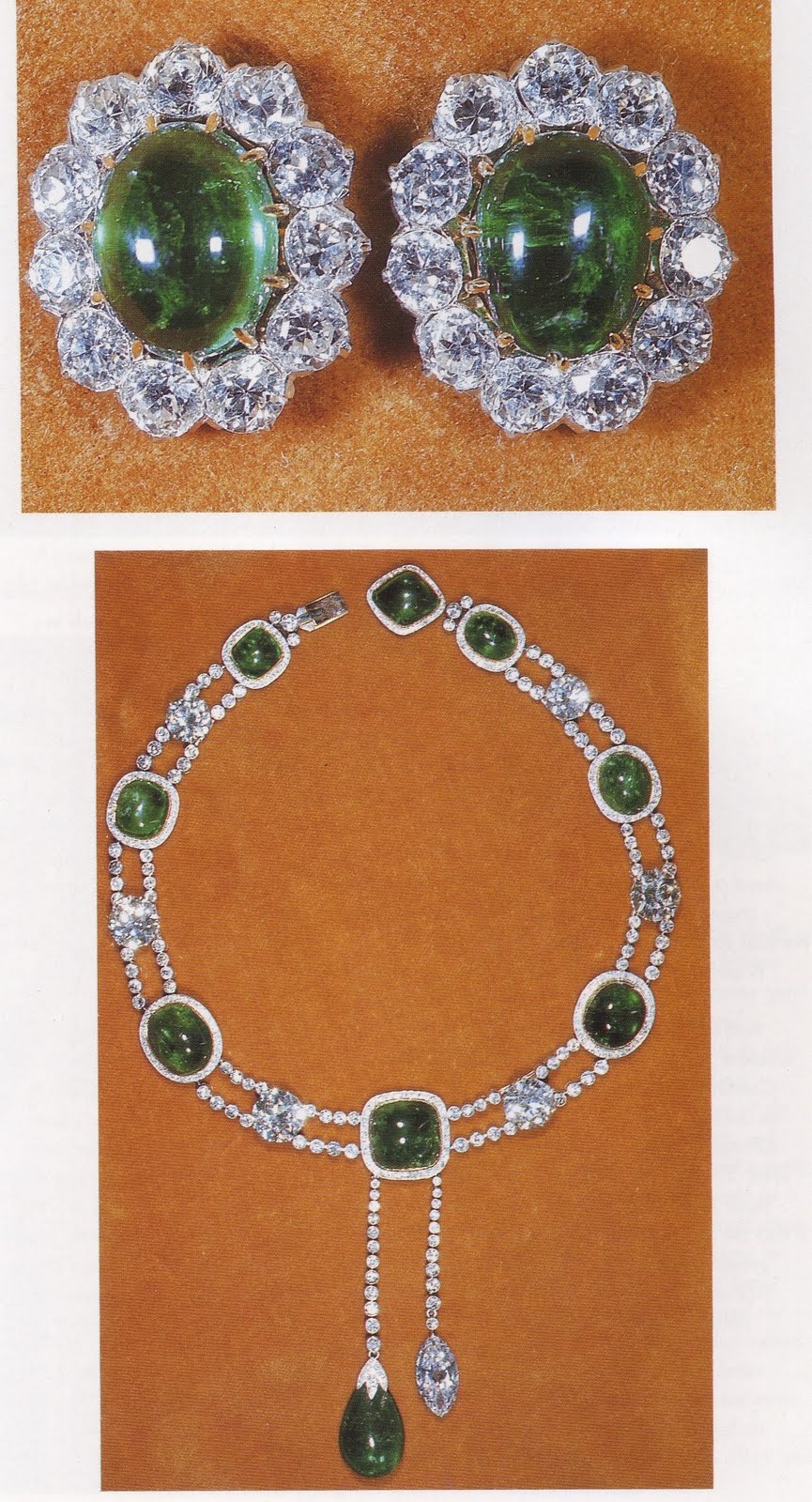
The Godman Necklace
This necklace was purchased by Frederick DuCann Godman, the noted naturalist, expert on the zoology of Central America and a British Museum Trustee, while on holiday in Bavaria in the 1890's. He gave it to his two daughters and in 1965, long after his death the elderly spinster sisters wrote to the Lord Chamberlain saying that they believed they owned a piece of jewellery that had once belonged to the Empress Josephine of France and it might be of interest to Her Majesty. Sir Francis Watson, Surveyor of the Queen's Works of Art, inspected the necklace, but found it did not match the detailed description of an emerald necklace in the inventory of the Empress's jewels. Despite the lack of royal connection, the Misses Godman said that they would like to present the necklace to the Queen, only requesting that she wear it occasionally. Although it is very rare for a member of the royal family to accept a personal gift from someone they don't know, this was felt to be a special occasion and the Queen, greatly touched by such a generous gesture, was delighted to add the necklace to her collection. As a thank you the Queen invited the Misses Godman to Buckingham Palace for a private audience.


Here the Queen wears the Godman necklace with Queen Victoria's Fringe Earrings- emerald drops framed by a swinging diamond fringe.

Queen Mary's Cluster Earrings
For her 59th birthday, on May 26, 1926, King George V presented Queen Mary with these earrings - large oval rubies each set in a cluster of nine brilliant cut diamonds.


Queen Elizabeth received these earrings from her parents in 1947. Here she is wearing them with a V-shaped diamond and ruby floral bandeau collar ending in a drop diamond pendant. This is of victorian workmanship and the Queen's parents purchased this as a wedding gift to the Queen

The Cambridge and Delhi Durbar Parure
This is the most magnificent parure of jewellery in the Queen's possession, was created by Queen Mary using stones from four different sources, and endures as a tribute to her taste and majestic sense of style. In 1818 Adolphus, Duke of Cambridge, 7th son of King George III, married Princess Augusta of Hesse. While they were visiting Frankfurt, a State lottery was held in aid of charity; the Duchess bought some tickets and won a small box containing some forty graduated cabochon emeralds. She used some of them to make a pair of drop earrings and a necklace. At her death in 1889 the earrings, necklace and remaining emeralds became the property of her youngest daughter, Princess Mary Adelaide, Duchess of Teck. When the Duchess died intestate in 1897, her jewellery was divided among her four children. Her son, the unmarried Prince Francis got the emeralds. Less than 6 months later, he died suddenly at the age of forty. He had given his mother's emeralds to his mistress, but within days of his funeral his sister Queen Mary bravely sent an emissary to the lady asking her to return the jewels, which she did. Queen Mary then used some of the Cambridge Emeralds and some Cullinan cleavings to make a completely new set of jewellery.

The Queen inherited the jewels on her grandmother's death in 1953 and wears it here in 1957. The emerald drops within the diamond circles on her tiara are also part of the Cambridge Emeralds

The King George VI Victorian Suite
In 1947 King George gave Princess Elizabeth a long necklace of oblong sapphires surrounded by round diamonds and separated by diamond collets as a wedding gift. To match it there was a pair of free-swinging squares shaped sapphire earrings bordered with diamonds and hanging from 3 collet stones. The suite was made around 1850. In 1952 the Queen had the necklace shortened by removing the largest stone plus one of the smaller sapphires and in 1959 a pendant was made using the big stone.

Princess Eliabeth photographed in her drawing room at Clarence House before leaving for an official visit to Kenya in 1952. King George VI died while she was there, and this picture was withheld from distribution until after the end of Court mourning on June 1, 1952. The necklace is its original length. When Noel Coward saw her wearing the suite at the 1954 Royal Command Performance at the Palladium, he wrote: "After the show we lined up and were presented to the Queen, Prince Philip and Princess Margaret. The Queen looked luminously lovely and was wearing the largest sapphires I have ever seen."

Next time - Pink Saturday

from the book - The Queen's Jewels by Leslie Fielding
Thursday, April 21, 2011

Countdown to the Royal Wedding - Coloured Stone Brooches

Welcome to the Gracie Jewellery countdown to the Royal Wedding- Part 7
8 Days to go.


Queen Mary's Russian Brooch
Queen Alexandra's sister, the Empress Marie Feodorovna of Russia, gave Princess May of Teck (the future Queen Mary) this brooch of a large square cut diamond and a square cut cabochon sapphire set in a scroll frame of round diamonds as a wedding present in 1893.

Queen Elizabeth wears the brooch in 1974

Queen Mary's Emerald Brooch I
Part of the Cambridge Emeralds, this cabochon emerald is surrounded by 2 rows of diamonds with an emerald drop

Queen Elizabeth wears one of her favourite brooches in 1979

The diamond and emerald scroll brooch also belonged to Queen Mary

The Prince Albert Brooch
A large oblong sapphire surrounded by twelve round diamonds was given to Queen Victoria by Prince Albert on February 9, 1840 at Buckingham Palace. It was the day before their wedding and Queen Victoria wrote in her diary "dearest Albert came upstairs to her sitting room and gave her four fans and a beaufiful sapphire and diamond brooch."

Queen Victoria wears the Prince Albert brooch on her wedding day.

Next time - Coloured Stone Necklaces

from the book - The Queen's Jewels by Leslie Fielding

Happy Birthday Queen Elizabeth April 21, 1926

Tuesday, April 19, 2011

Countdown to the Royal Wedding - Diamond Earrings

Welcome to the Gracie Jewellery countdown to the Royal Wedding - Part 5
10 Days to go.

Queen Mary's Cluster Earrings
Large brilliant cut diamonds set into a circle of diamonds, platinum setting with a millegrain edge.


Queen Elizabeth wears the earrings during her 1953 Christmas broadcast, during her 6-month long tour of Australia and New Zealand.

Queen Victoria's Stud Earrings
Perfectly matched large brilliant cut diamonds Queen Victoria had set on posts

This portrait was taken in 1873. Queen Victoria was 54.

Queen Elizabeth wearing the large diamonds in 1961.

The Queen's Pear Drop Earrings
Modern style earrings the Queen had made from family stones.

Diana, Princess of Wales wears the earrings on her first visit to Australia in 1983.

Next time - Bracelets

from the book The Queen's Jewels by Leslie Fielding

Monday, April 18, 2011

Countdown to the Royal Wedding -Diamond Necklaces

Welcome to the Gracie Jewellery countdown to the Royal Wedding - Part 4
11 Days to go.


Queen Victoria's Collet Necklace and Earrings
Made in 1858 this necklace adds up to 161 carats. The nine largest stones weighing between 8.25 and 11.25 carats. The pendant stone is known as the Lahore diamond and the drops in the earrings come from a ruby necklace she had been given.

Queen Elizabeth wore the set at her Coronation in 1953 and shown here in 1961 while on an official visit to Sierra Leone.

The King George Festoon Necklace.
Made in 1947, King George used 105 loose diamonds he had inherited.

Queen Elizabeth wears the necklace here in 1962.


The King Faisal of Saudi Arabia Necklace
The king bought this necklace of drop diamonds set with brilliant and baguette diamonds made by Harry Winston and presented it to the Queen in 1967 when he visited England.

Diana, Princess of Wales wears the King Faisal Necklace on a state visit to Australia in 1983.

Next time Diamond Earrings

from the book The Queen's Jewels by Leslie Fielding